





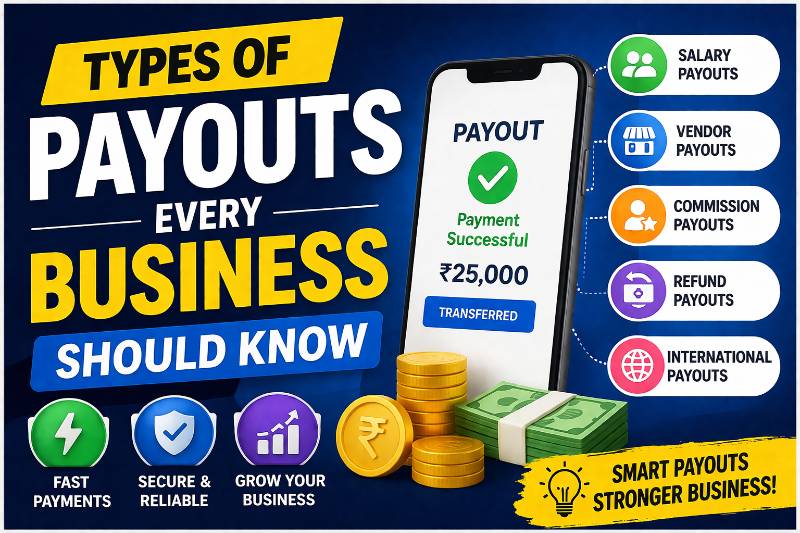
What Exactly Is a Payout?
A payout is any transfer of funds from a business to another party — a supplier, employee, customer, partner, or investor. While the word is deceptively simple, the mechanics behind different payout types vary wildly: the timing, method, compliance requirements, and accounting treatment can differ significantly from one category to the next.
Businesses that treat all payouts as "just sending money" often run into avoidable problems: delayed vendor relationships, incorrect tax withholdings, failed marketplace disbursements, or regulatory fines. Understanding the taxonomy of payouts is the first step to building a payment infrastructure that actually scales.
Note: "Payout" and "payment" are sometimes used interchangeably, but in financial operations, payouts specifically refer to outbound disbursements from a business — money going out, not in.
1. Vendor & Supplier Payouts
Vendor payouts are the bread and butter of business-to-business (B2B) finance. When your company purchases goods, raw materials, or services from a third party, the outbound payment is a vendor payout. These are governed by purchase orders, invoices, and payment terms.
Common payment terms include Net 30, where the full payment is due within 30 days of the invoice, and Net 60 or Net 90, used by large enterprises with extended cash cycles. The 2/10 Net 30 term offers a 2% discount if paid within 10 days, otherwise the full amount is due in 30 — a clever way to incentivise early payment. EOM or end-of-month settlement suits recurring monthly supplier invoices, while COD or advance payments are used with new vendors or high-risk orders.
Best practice: Automate invoice matching with your ERP to reduce manual errors and always capture early-payment discounts — they can add up to 24% annualised savings.
2. Employee & Contractor Payouts
Payroll is the most regulated category of business payouts. Whether you're paying full-time employees, part-time staff, or independent contractors, the compliance requirements differ significantly — and the penalties for getting it wrong are steep.
Fixed payroll covers monthly or bi-weekly disbursements to permanent employees with tax deductions at source. Variable payroll handles time-tracked wages for hourly or shift-based workers and must comply with minimum wage and overtime laws. Contractor payments are project or milestone-based, where the contractor handles their own taxes and the business must file a Form 1099 in the US or its equivalent elsewhere. Bonus and commission payouts are performance-linked, often taxed at a supplemental rate, and paid outside the regular payroll cycle.
Watch out: Misclassifying a full-time employee as an independent contractor is one of the most common and costly compliance mistakes. Audit your workforce classification annually.
3. Customer Refunds & Cashbacks
Customer-facing payouts directly impact satisfaction, loyalty, and your brand reputation. Slow or complicated refunds are a top driver of negative reviews. This category includes product refunds, service credits, loyalty cashbacks, and prize payouts.
Product returns and refunds involve a full or partial reversal of a purchase to the original payment method. Store credits issue value back to the customer's account rather than their bank or card. Cashback rewards return a percentage of a purchase over time, common in fintech and credit card products. Prize and contest payouts cover competition winnings disbursed via bank transfer, cheque, or voucher. Warranty replacements and reimbursements cover repair or replacement costs under a product guarantee.
4. Marketplace Seller Payouts
If you operate a marketplace — whether for physical goods, digital products, or services — you are responsible for collecting money from buyers and disbursing it to sellers, minus your platform fee. This is one of the most complex payout categories because you're acting as a financial intermediary.
Marketplaces must handle settlement timing, currency conversion, fee deductions, dispute holds, and tax reporting — often across multiple geographies. Operating a marketplace that holds and disburses funds may also trigger money transmission licensing requirements in your jurisdiction. Always consult a payments compliance specialist before launching.
Payout schedules vary widely. Daily payouts offer sellers maximum cash flow but require real-time reconciliation. Weekly payouts are predictable and manageable. On-demand payouts give sellers full control but require instant payment rails. Payouts triggered after delivery confirmation are the safest against fraud but the slowest for sellers.
5. Affiliate & Partner Payouts
Affiliate marketing has become a multi-billion dollar channel for customer acquisition. Affiliate payouts are commissions paid to publishers, influencers, or referral partners who drive sales or leads to your business.
Cost Per Acquisition, or CPA, is a fixed commission per confirmed sale or signup — the most common and easiest to track. Revenue share, known as RevShare, is an ongoing percentage of revenue generated by referred customers and works especially well for SaaS and subscription businesses. Cost Per Lead, or CPL, pays for each qualified lead delivered regardless of conversion, which is common in B2B. Tiered commissions are hybrid models where rates increase as volume grows, incentivising top-performing partners.
Fraud prevention is critical here. Implement hold periods — typically 30 to 60 days after conversion — before releasing commissions. This gives you time to identify chargebacks or fraudulent referral activity before funds leave your account.
6. Insurance & Claim Payouts
Insurance businesses have one of the most scrutinised payout obligations in any industry. A claim payout is triggered when an insured event occurs, and the speed, accuracy, and fairness of that payout defines the insurer's reputation.
In 2026, insurtech companies are using AI-driven claims processing to reduce settlement times from weeks to hours. Key payout types include life insurance death benefits, health claim reimbursements, property damage settlements, and business interruption claims.
Most jurisdictions mandate maximum claim processing and payment windows. Delays beyond these deadlines attract regulatory penalties and interest payments on the unpaid amount, making operational efficiency a legal and financial imperative, not just a customer experience goal.
7. Dividend & Investor Payouts
When a company generates profit, it may distribute a portion back to its shareholders as dividends. Investor payouts also include interest payments on bonds or loans, profit-sharing distributions in partnerships, and returns of capital in private equity structures.
Cash dividends are paid to shareholders and taxed as dividend income. Stock dividends are generally not taxable until the shares are sold. Bond interest is treated as ordinary income for the recipient. Profit distributions pass through to partners or LLC members' personal tax returns. Returns of capital reduce the investor's cost basis and are taxed on exit, which is the standard structure in private equity and venture capital funds.
8. Payout Methods Compared
Choosing the right payout method affects your operational cost, settlement speed, global reach, and recipient experience.
Bank transfers via ACH or NEFT take one to three days, cost very little, and work best domestically for payroll and vendor payments. Wire transfers via SWIFT take one to five days, cost more, but reach globally — suited to large international B2B transactions. Instant payments via UPI or RTP settle in seconds at low cost and are increasingly the standard for customer refunds and gig worker payouts. Debit and prepaid cards settle instantly, reach globally via Visa and Mastercard networks, and work well for the gig economy and contractor pay. Digital wallets are instant, relatively low cost, and global — popular with marketplace sellers and affiliate partners. Cheques and demand drafts take five to ten days and are increasingly legacy tools, used mainly for legal payouts or jurisdictions that still require paper. Cryptocurrency and stablecoins settle in minutes, carry very low fees, and reach globally — particularly valuable for cross-border payouts to unbanked recipients.
The 2026 reality is that instant payment rails like India's UPI, the UK's Faster Payments, and the US FedNow are now the default expectation in consumer-facing payouts. If your platform still relies on batch ACH for refunds, you're falling behind.
9. Choosing the Right Payout Model
There is no one-size-fits-all payout architecture. The right approach starts with mapping every type of payout your business makes and treating each category separately in your operations. Identify the compliance obligations for each type — tax, licensing, and reporting requirements vary. Assess recipient geography carefully, because domestic and cross-border payouts have fundamentally different requirements and costs.
Prioritise speed based on what your recipients actually expect, not just what's convenient for your cash flow. Choose a payout infrastructure that supports multiple payment rails under a single API, so you're not locked into one method. Build fraud controls in from the start — hold periods, velocity limits, and identity verification are not optional extras. Automate reconciliation from day one, because manual matching does not scale. Plan for exceptions such as failed payouts, returned funds, and dispute holds. Review your payout terms with your legal and tax team before launch, and revisit your entire payout strategy at least once a year, since regulations and available rails evolve quickly.
The Bottom Line
Payouts are far more than a back-office function — they are a competitive differentiator. Businesses that pay vendors promptly build better supplier relationships. Platforms that disburse to sellers quickly attract more merchants. Companies that refund customers instantly win loyalty.
In 2026, the infrastructure to handle every type of payout efficiently — at global scale, with embedded compliance — is accessible to businesses of all sizes. The winners will be those who treat payout strategy with the same rigour as revenue strategy.
Understanding the taxonomy is step one. Building the right infrastructure is step two. Start by auditing the payouts you make today — you may be surprised how many categories you're still running on manual processes.