






Get Api Key
Categories
Back to Home

Our Article

UPI Scams Every Business Owner Must Know

UPI Scams Every Business Owner Must Know

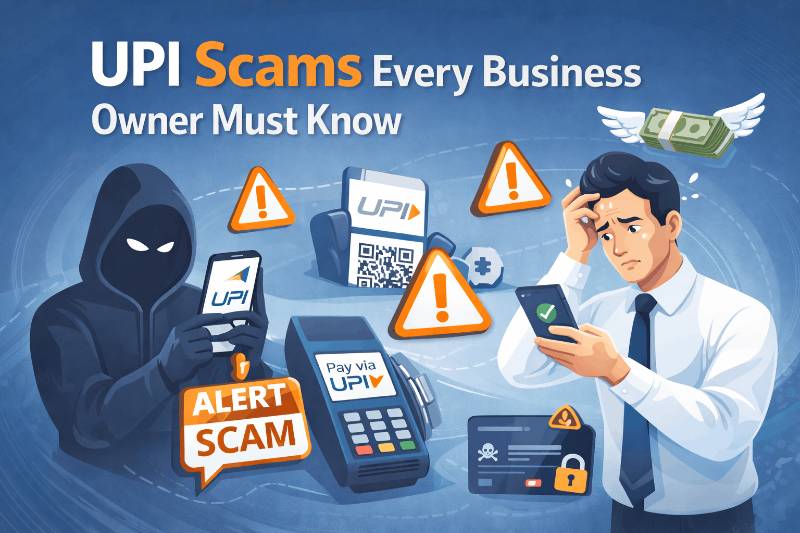
Illustration of UPI scam threats targeting business owners, featuring a scammer, payment terminal, warning icons, and a worried businessman using a smartphone.
Table of Contents
  • Loading table of contents...

India processed over ₹20 lakh crore in UPI transactions in a single month in early 2026. With that scale comes enormous risk. Fraudsters have grown more sophisticated — and their favourite targets are not individuals, but businesses. If you run a shop, a startup, or even a freelance operation, you need to know exactly how these scams work before they cost you everything.

₹2,400 CrUPI fraud reported in FY25
67%Rise in business-targeted scams
3 secHow fast money is gone once sent

Unlike credit card fraud where banks offer some chargeback protection, UPI payments are instant and largely irreversible. Once a fraudster receives the money, recovering it is close to impossible without immediate police action. The burden falls squarely on you to prevent it in the first place.

Here are the most dangerous UPI scams targeting business owners in 2026 — and exactly what you must do to stay protected.

Scam 01The "Wrong Transfer" Refund Trap

This is the oldest UPI scam but it keeps evolving. A stranger calls you claiming they accidentally transferred money to your UPI ID. They sound panicked, sometimes they even send you a fake screenshot. You check your account — and yes, there's money sitting there.

How it works against businesses

The fraudster sends real money from a stolen account. They ask you to "refund" it to a different UPI ID — theirs. You refund believing you're doing the right thing. Later, the original victim files a fraud complaint. Your account gets flagged and the initial amount is reversed — but your refund is already gone.

You lose twice: the refund amount AND face potential legal scrutiny for receiving stolen funds.

🚨
Never refund to a different account than the original sender. If someone claims to have sent money by mistake, ask them to raise a reversal request through their own bank or UPI app. That is the correct process — any deviation is a scam.

Scam 02Fake Payment Screenshots & SMS Spoofing

For retail businesses, restaurants, and delivery services, this scam is a daily threat. A customer places an order and shows you a payment success screenshot — it looks completely real, with your store name, the correct amount, even a transaction ID.

The deception

The screenshot is either AI-generated or taken from a real transaction and edited. Some fraudsters use apps that send a fake SMS that looks exactly like a UPI confirmation message. Your cashier, under pressure from a queue of customers, hands over goods before verifying.

In 2026, AI-generated receipt images have become nearly indistinguishable from real ones.

✅ Business RuleNever release goods or services until you see the credit appear in your own UPI app or bank account. A screenshot proves nothing. Train every single employee who handles payments on this rule — no exceptions, no matter how genuine the customer looks.

Scam 03Collect Request Scam (The "Pay to Receive" Trick)

This scam specifically targets business owners who are expecting payments. You receive a UPI collect request — it looks like a payment coming IN. The notification says something like "₹15,000 payment from [Customer Name]." You enter your PIN to "accept" it.

"I thought I was receiving a payment from a client. The moment I entered my PIN, ₹18,000 left my account. I realised it was a debit only when I got the confirmation SMS." — A Delhi-based supplier, 2025

This is perhaps the cruellest scam because it exploits the confusion between sending and receiving. UPI collect requests require you to approve and debit your own account. No legitimate payment ever requires you to enter your PIN — your PIN is only for sending money.

🔐
Your UPI PIN is only for sending money, never receiving. If anyone asks you to enter your PIN, approve a collect request, or scan a QR code to "receive" a payment — stop immediately. That is a scam, always.

Scam 04Vendor Impersonation & Invoice Fraud

This scam is growing rapidly among SMEs and growing businesses. A fraudster researches your regular vendors — often through LinkedIn, your website, or social media. They then impersonate the vendor via email, WhatsApp, or even phone and inform you of a "new bank account" or "updated UPI ID."

How the attack unfolds

The fraudster sends a professional-looking email or message with the vendor's logo and a slight change in the email address (e.g., vendor@gmail.com instead of vendor@company.com). Your accounts team updates the payment details and sends the next invoice payment — to the fraudster.

In many cases, the real vendor only discovers the issue weeks later. By then, multiple payments may have gone through.

  • Always verify any change in payment details via a direct phone call to a known number — not the number provided in the suspicious message.
  • Never change vendor UPI/bank details based solely on email or WhatsApp requests.
  • Maintain a verified contact directory for all major vendors and update it only after multi-step verification.
  • If your business sends large payments, implement a dual-approval process for any new or changed payment destination.

Scam 05QR Code Tampering at Your Own Store

You may be the victim without even knowing it. Fraudsters physically visit stores — especially small shops, dhabas, medical stores, and parking areas — and place a sticker with their own QR code over yours. Every customer who pays gets debited, but the money goes to the scammer, not you.

This scam can run for days before a business owner notices the gap between sales and deposits.

✅ Prevention ProtocolCheck your QR code display every morning before opening. Laminate your QR code so stickers cannot easily be placed over it. Better yet, use a printed QR code behind a glass frame. Periodically scan your own QR with a personal phone to confirm it points to your correct UPI ID.

Scam 06Fake GST Refund & Government Scheme Scams

Fraudsters pose as GST officials, Income Tax officers, or representatives from MSME schemes. They tell business owners they are eligible for a GST refund, a government subsidy, or a loan approval — and all that's needed is to "verify" your UPI ID by sending a small test transaction.

Some go further and set up convincing fake government portals with ".org" or ".co.in" domains. Business owners fill in their UPI details, complete a verification transaction, and receive nothing in return.

🏛️
No government scheme requires you to send money to receive money. All legitimate GST refunds, subsidies, and scheme disbursements go directly to your registered bank account — they never ask for UPI payments or test transactions. Hang up, log off, and report.

Scam 07SIM Swap & UPI Account Takeover

This is the most technically sophisticated attack. A fraudster collects your personal details — name, date of birth, Aadhaar number — often from data breaches or social engineering. They visit a mobile store with forged documents and get your SIM deactivated, and a new SIM issued in their name.

With control of your phone number, they take over your UPI accounts, reset PINs, and drain linked bank accounts. Business owners with high account balances are prime targets.

  • Register for SIM swap alerts with your telecom provider — most now offer SMS or app notifications.
  • If your phone suddenly loses network for an extended period, call your carrier immediately — do not assume it is a technical issue.
  • Enable two-factor authentication on your banking and UPI apps wherever available.
  • Keep your UPI accounts linked to a business SIM that is not widely shared or publicly listed.

Scam 08Fake Bulk Order Scams Targeting Suppliers

If you are a supplier, manufacturer, or wholesale dealer, this one targets you directly. A "buyer" contacts you with a large bulk order — often an amount that seems too good to pass up. They send an advance via UPI to build trust, then request a partial shipment urgently.

Once you ship, they claim a "refund" of the advance (using the collect request trick or a false technical error) and disappear. You lose both the stock and the advance amount.

Red flags to watch for

Unusually large first-time orders from unknown contacts. Pressure to ship quickly before payment fully clears. Buyers who are eager but vague about their business or address. Requests to "test" your UPI by receiving a small amount first.

What To Do If You've Been Scammed

Speed is everything. UPI frauds can sometimes be partially recovered if reported within hours.

  • Call the National Cybercrime Helpline:1930— available 24/7. Report within the first hour if possible.
  • File a complaint atcybercrime.gov.inwith all transaction details, screenshots, and UPI IDs.
  • Contact your bank's fraud helpline immediately and request a hold on suspicious transactions.
  • File an FIR at your local police station — this is required for any bank-level investigation.
  • Report the fraudulent UPI ID through your UPI app (PhonePe, GPay, Paytm all have in-app reporting).

The Smartest Business Defence

In 2026, UPI fraud is not a rare event — it is an industry. Organised criminal networks run sophisticated operations targeting Indian businesses 24 hours a day. The good news: almost every scam on this list is preventable with awareness and simple process discipline.

Educate every person in your business who touches a payment. Put processes in place — verification calls for vendor changes, daily QR checks, a strict "no PIN for receiving" rule. The fraudsters rely on speed, confusion, and trust. Slow down, verify, and question anything that feels slightly off.

Your PIN. Your money. Your responsibility.                                                                                                                                                                                                                                                                                                                                                                                                                                                                                                                                                                                                                                                                                                                                                                                                                                                                                                                                                                                                                                                                                                                                                                                                                                                                                                                                                                                                                                                                                                                                                                                                                                                                                                                                                                                                                                                                                                                                                                                                                                                                                                                                                                                                                                                                                                                                                                                                                                                                                                                                                                                                                                                                                                                                                                                                                                                                                                                                                                                      
Previous
Payment approved. So why is the money not in your...
Next
Digital Marketing on a Budget

Get the latest data trends & insights on CGPEY!

0+
Clients
Domestic and International Payments
0.0+
Stores, Apps & websites